Manual.ly Logo

JBL Aquaristic ProAquaTest Lab Bruksanvisning

0,0 · 0 Betyg

PDF-manual · 65 Sidor

Svenska

M: QW-35-FL
sida

/ 65

Loading...
20bbaef5bdec311f8d8e156c4e1fe9d6e449 page 9
16 17
deciency. Iron and some other trace elements are only sta-
ble in water for a limited time, even if they are bound to so-
called chelators, as is usual in modern fertilisers. In addition
any tap water added is usually iron-free. Therefore, the iron
content needs to be monitored regularly with this test and re-
plenished if necessary. Cncentrations as low as 0.1–0.2 mg/l
are sufcient for good plant growth. In very densely planted
aquariums, values of up to 0.6 mg/l can also be useful. In
marine water, values of up to 0.05 mg/l are recommended.
Procedure:
1. Rinse both test vials several times with the water to be
tested.
2. Use the enclosed syringe to ll each of the test vials with
5 ml of sample water.
3. Add 5 drops of Fe reagent to one of the two test vials and
mix by swirling. Allow to stand for 10 minutes until the
colour has developed completely.
4. Place both test vials in the grey comparator block: Place
the vial with added reagent at the smooth end and the
vial with untreated sample water (blank sample) at the
notched end of the comparator block.
5. Place the comparator block with the two test vials on the
colour chart in such a way that the notch points to the
values and move it on the colour chart until the colour of
the sample mixed with reagents corresponds as closely
as possible to the colour under the blank sample.
6. Read the iron content in the notch of the comparator.
Note:If you decide to use the JBL PRO AQUATEST NH
4
at
the same time, make sure you don’t mix up the measuring
vessels of either set. Traces of the JBL PRO AQUATEST
NH
4
left inside the measuring vessel may result in too high
readings in the iron test.
Correcting deviating values:
Too low: Fertilise with ferrous fertilisers from the JBL ferti-
liser range (e.g. JBL Ferropol).
Too high: Carry out the corresponding partial water change.
JBL PRO AQUATEST K
Features: JBL PRO AQUATEST K is an easy-to-use turbid-
ity test for the routine monitoring of the potassium content in
fresh and marine water.
Why test? Potassium is one of the macroelements which is
very effectively absorbed within a few hours and temporarily
stored by plants in fresh water. Growing plants require more
potassium compared to other elements. As a result, potas-
sium concentrations can drop to a minimum range, causing
plant growth to stagnate, even if the aquarium water is ferti-
lised regularly. Potassium deciency initially leads to chloro-
tic spots on the edges of the leaf, which gradually increase
and then turn into grey-brown necroses. The leaves may
crinkle or curl. In Central European tap water, potassium is
usually a decient element compared to in natural biotopes
and this especially applies to calcium and magnesium con-
centrations. For good plant growth, the potassium content
needs to be at around 10 mg/l, in aquariums with high il-
lumination (e.g. in so-called scapes) up to 30 mg/l can be
useful. Higher potassium values in aquarium water encour-
age the growth of green thread algae. Potassium is present
in seawater in concentrations of about 380–400 mg/l, but is
only consumed in small quantities. Excessively high potas-
sium contents can be dangerous for sensitive animals such
as shrimps. The potassium content of the aquarium water
needs to be measured on a daily basis initially. This enables
the needs of the plants to be determined and the dosage of
the fertiliser can be carried out accordingly. Afterwards, rou-
tine measurements can be carried out after longer intervals.
Procedure:
Freshwater:
1. Rinse the measuring tube (plastic) and the tube (glass)
for the potassium content reading several times with the
water to be tested.
2. Using the syringe supplied, ll 15 ml of sample water into
the measuring tube.
3. Add 10 drops of reagent 1 and mix by swirling.
4. Add 1 large level measuring spoon (broad end of the
enclosed double-ended spoon) of reagent 2 and swivel
slightly for about 30 seconds until the powder has dis-
solved. The water becomes whitish and cloudy. Leave to
stand for 1 minute and then swirl slightly again.
5. Place the glass tube for reading the potassium content
reading on the cross of the colour card.
6. The following procedure should be carried out in bright,
diffuse light. Pour the´ turbid water from the measuring
tube into the reading tube until the turbidity means the
cross on the colour card is no longer visible from above.
7. The potassium content can now be read on the scale of
the tube (bottom of the meniscus).
Marine water:
1. Fill 10 ml sample water with distilled water to 300 ml.
2. Follow the same steps as for fresh water.
3. Multiply the test result by a factor of 30.
Correcting deviating values:
Too low: In freshwater aquariums fertilise with potassium-
containing fertilisers from the JBL ProScape range. We do
not recommend an additional dosage in marine water be-
cause potassium is toxic for various organisms.
Too high: Repeat the measurement after 24 hours. If the
value is still too high, carry out the corresponding partial
water change.
JBL PRO AQUATEST Cu
Features: JBL PRO AQUATEST Cu is an easy-to-use color-
imetric test to routinely determine the copper content in fresh
and marine water aquariums, and in garden ponds. A com-
pensation method developed by JBL allows reliable results
to be obtained even in slightly discoloured water (caused by
peat ltering or disease treatment etc.).
Why test? Copper is a heavy metal which is on the one
hand indispensable as a trace element for plant and animal
organisms. On the other hand it has a devastating effect
as a cell poison (cytotoxin) above a certain concentration.
Copper mainly reaches the aquarium in tap water, as cop-
per pipes were often used for water installation. If the water
remains in such pipes for a longer period of time, consid-
erable amounts of copper can dissolve. The water in the
pipe should therefore be drained before use. For the same
reason, do not use rainwater that has owed over copper
gutters. And make sure the tools you use when setting up
your aquarium or pond are copper-free. A controlled entry
of copper takes place through the application of medications
against parasitic sh diseases, as well as with some algae-
killing agents. The copper concentrations prescribed for this
can be tolerated by sh for a certain time while parasites,
etc., start dying off immediately.
Please note: Copper quickly forms water-insoluble com-
pounds which form deposits on the ground. The JBL PRO
AQUATEST Cu only detects copper dissolved in water.
Procedure:
1. Rinse both test vials several times with the water to be
tested.
2. Use the enclosed syringe to ll each of the test vials with
5 ml of sample water.
3. Add 5 drops of reagent 1 to one of the two test vials and
mix by swirling. Then add 5 drops of reagent 2 and mix
again. Allow to stand for 15 minutes until the full colouring
develops.
4. Place both test vials in the grey comparator block: Place
the vial with added reagent at the smooth end and the
vial with untreated sample water (blank sample) at the
notched end of the comparator block.
5. Place the comparator block with the two test vials on the
colour chart in such a way that the notch points to the
values and move it on the colour chart until the colour of
the sample mixed with reagents corresponds as closely
as possible to the colour under the blank sample.
6. Read the copper content in the notch of the comparator.
Correcting deviating values:
Too low: The value should always remain below the detec-
tion limit (except for some special treatments).
Too high: Regular use of JBL water conditioners, such as
JBL Biotopol or ltering with JBL’s high performance acti-
vated carbon. Water-insoluble copper compounds can only
be eliminated by removing the complete substrate.
JBL PRO AQUATEST O
2
Features: JBL PRO AQUATEST O
2
is an easy-to-use colori-
metric test for the routine monitoring of the oxygen content
in fresh and marine water aquariums, and in tap and garden
pond water, within a range of 1–10 mg/l (ppm).
Why test? All animals living in water need oxygen to
breathe. Even the „invisible helpers“ in aquariums and
ponds, the cleansing bacteria, are dependent on a suf-
cient oxygen content for the conversion of ammonium to
nitrate. The oxygen supply they need can be safeguarded
by adequate planting. In aquariums and ponds with little or
no planting and in marine aquariums, the oxygen content
always needs to be kept at the appropriate saturation value
with the help of technical equipment. The saturation value
depends on the water temperature (see table on last page).
Plants are able to exceed this saturation value through their
assimilation activity. In well planted aquariums and ponds,
for example, values can be found towards the end of the
lighting period, which are 1 to 2 mg/l higher than the satura-
tion value.
Procedure:
1. Rinse the measuring vessel several times with the water
to be tested.
2. Fill the measuring vessel to the brim with the water to be
tested by immersing it in water and place it on a water-
proof surface.
3. Add 6 drops of O
2
reagent 1 and 6 drops of O
2
reagent
2 slowly one after the other, until the measuring vessel
overows.
4. Avoiding bubble formation, close the measuring vessel
bubble-free with the enclosed cap and shake vigorously
for approx. 30 seconds.
5. Remove the cap from the measuring vessel and add 6
drops of O
2
Reagent 3.
6. Close the measuring vessel again (bubbles no longer
matter) and shake vigorously for approx. 30 seconds. Al-
low to stand for 10 minutes until the full colouring devel-
ops.
7. Move the measuring vessel back and forth approx. 3–5
cm above the white part of the colour chart and select the
colour with the best possible match.
8. Read the oxygen content off the relevant colour eld.
Correcting deviating values:
Too low: Put in more plants and/or improve care of exist-
ing plants, e.g. by installing a CO
2
supply unit (JBL ProFlora
CO
2
kit). Improve ventilation, e.g. with a JBL ProSilent air
pump and/or improve water movement on the surface with
ow pumps, protein skimmers (marine water) or in garden
ponds with stronger pumps (pond lters) in conjunction with
a waterfall or watercourse.
Too high: Not applicable.
JBL PRO AQUATEST CO
2
Direct
Features: JBL PRO AQUATEST Ca is an easy-to-use titra-
tion test to determine the carbon dioxide content of fresh-
water.
Why test? Carbon dioxide (CO
2
) is the most important plant
nutrient. The consumption of CO
2
differs from aquarium to
aquarium and depends, amongst other things, on the fol-
lowing factors: number and demands of plants, carbonate
hardness, water movement and light. Fertilisation with CO
2
is usually done with a CO
2
fertiliser system. In the aquarium
water, a CO
2
content between 15 and 30 mg / l is recom-
mended. This range is safe for sh and at the same time en-
sures luxuriant plant growth. 20–25 mg/l CO
2
has proven to
be ideal. In special aquariums with a large number of plants,
so-called scapes, higher values of up to 35 mg/l may be re-
quired. With this test you can determine the CO
2
content of
your aquarium water in mg/l and thus monitor the setting of
your CO
2
fertiliser system.
Please note: When fertilising with so-called liquid carbon,
fertiliser monitoring with JBL PRO AQUATEST CO
2
Direct is
not possible because these fertilisers do not contain CO
2
but
other carbon compounds.
Procedure:
1. Rinse the measuring vessel and syringe several times
with the water to be tested.
2. Using the syringe, insert 20 ml of bubble-free sample
water into the measuring tubes.
3. Place the measuring tube on both elds of the enclosed
colour chart.
4. Pour 5 drops of reagent 1 into the measuring tube on the
white eld and swirl it until it is mixed.
5. Add reagent 2 drop by drop. After each drop, swirl and
count the drops until a pink colour is obtained which re-
mains stable for 60 seconds and corresponds to the col-
our in the second measuring tube on the pink colour eld.
To compare the colours, look into the tubes from above.
6. The number of drops multiplied by 2 gives the carbon di-
oxide content in mg/l. Example: 10 drops of reagent 2 =
20 mg/l CO
2
.
Since other acids in the water impair the measurement, a
blank value must also be determined. To do this, take a wa-
ter sample of 100 ml and aerate it for 15 min using a JBL
ProSilent air pump with an air stone. Then determine the
blank value according to the instructions given above.
Result–blank value = actual carbon dioxide concentration
in mg/l.
Correcting deviating CO
2
values:
Too low: Add carbon dioxide to the aquarium using a JBL
ProFlora CO
2
fertiliser system.
Too high: Aerate the aquarium using a JBL ProSilent air
pump.
CO
2
table
Special feature: The CO
2
table enables you to determine
the carbon dioxide content through the carbonate hardness
(KH) and the pH value of the water. This method should only
be used if no pH-lowering substances, such as nitrate or
peat, are in the water.
Why test?
Carbon dioxide (CO
2
) is the most important plant nutrient.
The consumption of CO
2
differs from aquarium to aquarium
and depends, amongst other things, on the following factors:
number and demands of plants, carbonate hardness, water
movement and light. Fertilisation with CO
2
is usually done
en
en
en
en
en

Chatta med din JBL Aquaristic ProAquaTest Lab-manual med hjälp av AI

Få omedelbara AI-svar från din JBL Aquaristic ProAquaTest Lab-manual

Fråga vad som helst om JBL Aquaristic ProAquaTest Lab. Svaren kommer från denna bruksanvisning, med de sidor de bygger på.

ProAquaTest Lab Underhallsschema

Dagligen
Mät magnesiuminnehållet i sötvattensakvariet

Mät dagligen i början för att bestämma växtbehov och gödseldos. Byt till längre intervall efteråt.

Visa i manualen (sida 3)
Dagligen
Mät kaliuminnehållet i sötvattensakvariet

Mät dagligen i början för att bestämma växtbehov och gödseldos. Byt till längre intervall efteråt.

Visa i manualen (sida 9)
M: qwen/qwen3.8-flash

Ställ en Fråga

0/1000

Rekommenderar du ProAquaTest Lab?

Ja Nej

Vanliga frågor

A

För att säkra noggranna resultat, skölj alla behållare flera gånger med provvatten innan testning. Håll droppare vertikalt för att undvika luftbubblor. Följ specifika väntetider för färgutveckling. Jämför färger mot tabellen på vit bakgrund. Använd de medföljande sprutorna och jämförelsebaskarna för konsekventa volymer.

Är detta svar till hjälp?

A

Svängningar i pH kan skada vattenorganismer. Plötsliga förändringar är särskilt stressande. Färgat vatten kan störa avläsningar men kompensationmetoder hjälper. Mät alltid vid samma tid på dagen då ljus påverkar CO2-nivåer och pH. Undvik testning omedelbart efter tillsättning av kemikalier eller mat.

Är detta svar till hjälp?

A

Kontrollera kritiska parametrar som pH och ammonium regelbundet, särskilt i nya setup. Testa näringsämnen som nitrat och fosfat månadsvis när systemet är stabilt. Kontrollera GH och KH veckovis för att övervaka hårdhetstrender. Testa syrenivåer om fisk visar tecken på stress eller i tätpackade tankar. Frekvens beror på fyllnadsgrad och tankstorlek.

Är detta svar till hjälp?

A

Ja, handboken täcker färskvattenakvarium, marina akvarier och trädgårdsdamm. Specifika tester finns för Koi-damm med hög fyllnadsgrad. Allmän hårdhet och pH-tester gäller för de flesta färskvattenmiljöer. CO2-tester är specifika för planterade akvarier med aktiv plantillväxtcykler.

Är detta svar till hjälp?

A

Högt ammonium indikerar ett problem med det biologiska filtret. Utför ett stort partiellt vattenbyte omedelbart. Tillsätt nyttaiga bakterier för att återställa kvävecykeln. Kontrollera om sjukdomsmediciner som nyligen använts har skadat nyttaiga bakterier. Säkerställ att utfodringen minskas tills nivåerna återgår till säkra gränser. Övervaka pH eftersom det påverkar ammoniums toxicitetsnivåer.

Är detta svar till hjälp?

A

Korrigera låg karbonathårdhet genom att tillsätta JBL-vattenkonditionen som innehåller vätekarbonater. Du kan också använda mineralsaltsblandningar designade för akvarier. Undvik mjukning av vatten om det redan är för lågt. Övervaka noggrant efter justering för att förhindra pH-svängningar. Testa om igen efter 24 timmar för att bekräfta stabilitet.

Är detta svar till hjälp?

A

Förvara reagenser torra vid rumstemperatur i originalförpackningen. Håll dem borta från direkt solljus och värmekällor. Se till att droppare är torra på utsidan innan återgången till flaskor. Blanda inte lock mellan olika testset. Kontrollera utgångsdatum regelbundet då gamla reagenser kan ge felaktiga resultat.

Är detta svar till hjälp?

M: QW-35-FL

Fördelar och Nackdelar

Fördelar

  • Utbredt utbud av tester som täcker alla nyckelparametrar för olika vattenuppsättningar inklusive färskvatten, marina och trädgårdsdamm
  • Avancerad kompensationsteknik säkerställer tillförlitliga resultat även i vatten färgat av torvfiltrering eller behandlingar
  • Detaljerade procedurer minimerar användarfel och inkluderar visuella hjälpmedel som färgdiagram för enkel tolkning av mätningar
  • Reagenser är stabila och effektiva när de förvaras korrekt vilket möjliggör långsiktig konsekvent övervakning av vattenkemi
  • Specifika medföljande verktyg förenklar testprocessen vilket gör den tillgänglig för nybörjare samtidigt som den förblir korrekt för experter
VS

Nackdelar

  • Vissa tester kräver färgavläsning inom 15 minuter för att säkerställa noggrannhet innan lösningsfärgen ändras
  • Användare måste säkerställa att testbehållare inte blandas mellan olika testset för att undvika korskontaminering av prover
  • Noggrannhet beror på noggrann droppräkning och hållning av droppare vertikalt vilket kräver uppmärksamhet på detaljer
  • Rättelse av höga toxinnivåer kräver ofta omedelbara stora volymvattenbyten vilket kan vara störande
  • Reagenser kan förändras över tid om de inte förvaras i originalförpackning borta från värme- och fuktkällor
M: QW-35-FL

Produkt Specifikation

Intervall

Vattenvärden

Typ

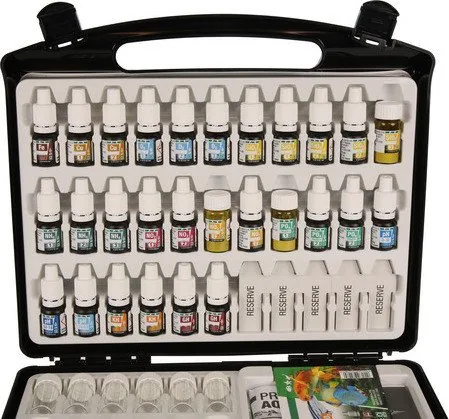
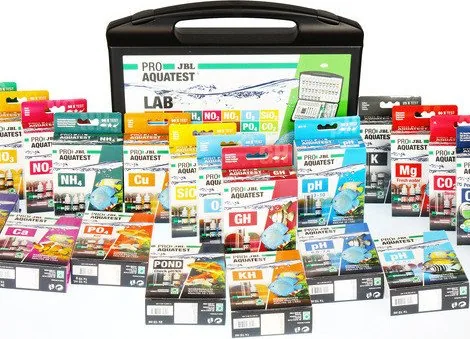
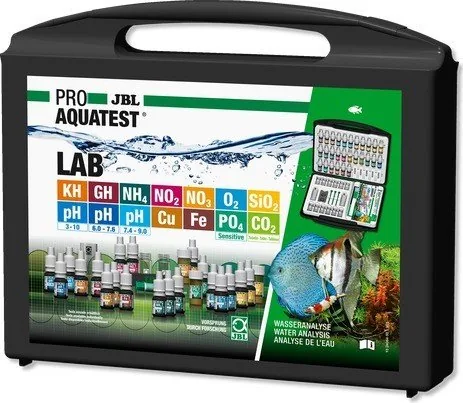
Vattentest (pH (3 intervall), Karbonathydrighet, Total hårdhet, Fosfat, Nitrit, Nitrat, Järn, Koppar, Silikat, Syre, Ammonium, Ammoniak, CO2 indirekt), Testset

Dimensioner

38,20x8,51x31,80cm (BxHxD)

Vikt

1,27 kg

M: QW-35-FL

Produkt Beskrivning

Bemästra akvarievattenkemi

Att upprätthålla en hälsosam vattenmiljö kräver noggrann övervakning av vattenkemin för att säkerställa alla organismer som lever inuti. JBL Pro AquaTest Lab Testfodral Handbok ger väsentlig vägledning för hobbyister som kräver utmärkelse i sina akvariemiljöer för att hålla toppskick. Denna omfattande samling säkerställer att dina fiskar och växter frodas i optimala förhållanden genom att ge detaljerade instruktioner för olika analysmetoder som används idag.

Viktiga Testmetoder för Klarhet

Vattenkvalitet bestämmer framgången för vilket akvarium som helst oavsett de specifika arter du håller. Oavsett om du håller färskvatten eller marina liv eller Koi i trädgårdsdamm krävs specifika parametrar med specifik uppmärksamhet för stabilitet. Handboken detaljerar sofistikerade titrering- och kolorimetriska metoder designade för noggrannhet och enkel användning för alla. Titreringstester som KH och GH använder exakta droppantal för att bestämma hårdhetsnivåer effektivt över tid. Kolorimetriska tester som pH och väsentliga näringsämnen förlitar sig på färgdiagram för klara och läsbbara resultat för snabba kontroller. Varje test inkluderar steg-för-steg procedurer för att minimera användarfel under processen med att testa vattenprover. Systemet kompenserar effektivt för vattenfärgning som orsakas av torvfiltrens eller behandling för att säkerställa tillförlitlighet även under utmanande förhållanden.

Vitala Parametrar täckta för Hälsa

Att förstå din vattenprofil är avgörande för att förhindra farliga svängningar som skadar känsliga varelser. Hårdhetstester som Pro AQUATEST GH och KH förhindrar farliga pH-svingningar som skadar känsliga varelser avsevärt. pH-nivåer mellan specifika intervall passar olika arter från surt färskvatten till alkalinska marina akvarier perfekt. Näringsämnenstestning övervakar komplexa kvävecykler som Ammonium, Nitrit och Nitrat för att spåra systemfunktion noggrant. Fosfat- och Silikatnivåer hjälper till att förhindra segalgblommor som kan kväka din tank och döda fiskar. Spårämnen som Järn och Koppar är viktiga för tillväxt men måste kontrolleras strikt för att undvika toxicitetsrisker. Syrenivåer säkerställer livsunderstöd för fiskar och bakterier medan CO2-gödning hjälper till med frodiga plantillväxt i planterade akvarier.

Underhåll och Korrigeringar för Stabilitet

Att hålla parametrar stabila undviker stress och sjukdomsutbrott i ditt ekosystem på lång sikt. Om avvikelser från rekommenderade intervall erbjuder guiden specifika korrigeringssteg för justering att fixa problem. För låg hårdhet kräver tillsättning av mineralsalter medan överskott tyder på att använda omvänd osmosfiltrering för att minska det. Näringsbrist behöver specifika gödningstillsatser från ProScape sortimentet som är lätt att köpa online. Höga toxinnivåer kräver omedelbara vattenbyten eller introduktion av biologiska filter för att återställa balans snabbt. Förvaringsinstruktioner säkerställer att reagenser förblir effektiva för framtida testperioder innan de utgår. Droppare måste hållas vertikalt för att förhindra luftbubblor under dispenseraren av reagenser. Regelbundna kontroller förhindrar oväntade överraskningar i din underhållsrutin för dina tankar. Genom att följa JBL Pro AquaTest Lab Testfodral Handbok vägledningen kan akarieägare uppnå vattenklarhet och stabilitet för sina husdjur.

M: QW-35-FL

© Copyright 2026 Manual.ly